This brief compares four ways owner-operators can take value out of a business: a strategic sale, a majority recapitalization, a minority investment, and a debt recapitalization. They trade control, cash, and upside differently, and in the lower middle market they are not all equally available. This brief covers what each option tends to look like at your size, and the order to make the decision in.
Selling the whole business is one path. These four doors help frame the trade-offs, though they do not cover every exit or succession arrangement.
What are the four exit options for a business owner?
The four options covered here are a strategic sale of the whole company, with the amount and timing of cash determined by the deal terms; a majority recapitalization, where a private equity sponsor takes control and you roll a minority stake alongside them for a second bite of the upside; a minority investment, which can give partial liquidity while you retain majority ownership, subject to negotiated investor rights; and a debt recapitalization, where you borrow against the business, pay yourself a dividend, and keep 100 percent ownership.
That menu comes from J.P. Morgan's Small Cap Investment Banking team, in a recent piece called “How America's Founder-Led Businesses Can Prepare For The Next Chapter.” The piece quotes Michael Flynn, who heads that team. It is a bank's advisory marketing piece, not survey research, and I read it that way: a useful map of how one desk sees the choices.
One number sets the stage for business owners thinking about an exit. Citing a McKinsey Institute for Economic Mobility white paper, the piece reports that more than half of all business owners in the United States are over 55, up from roughly 30 percent in 2002, and one in four is 65 or older. A generation that built companies is at the age where the question stops being theoretical.
Their team serves companies between $100 million and $500 million in enterprise value. That is a different country from the one most readers of this brief live in. What carries across the size line is the menu itself and the demographic pressure behind it. What tends not to carry is everything around it: the institutional process, the buyer benches, and the price environment. Flynn puts the average multiple paid in mid-cap deals at around 10 times, without naming the metric, and notes that businesses with diligence issues sell for less. That number belongs to their segment, and I will leave it there.
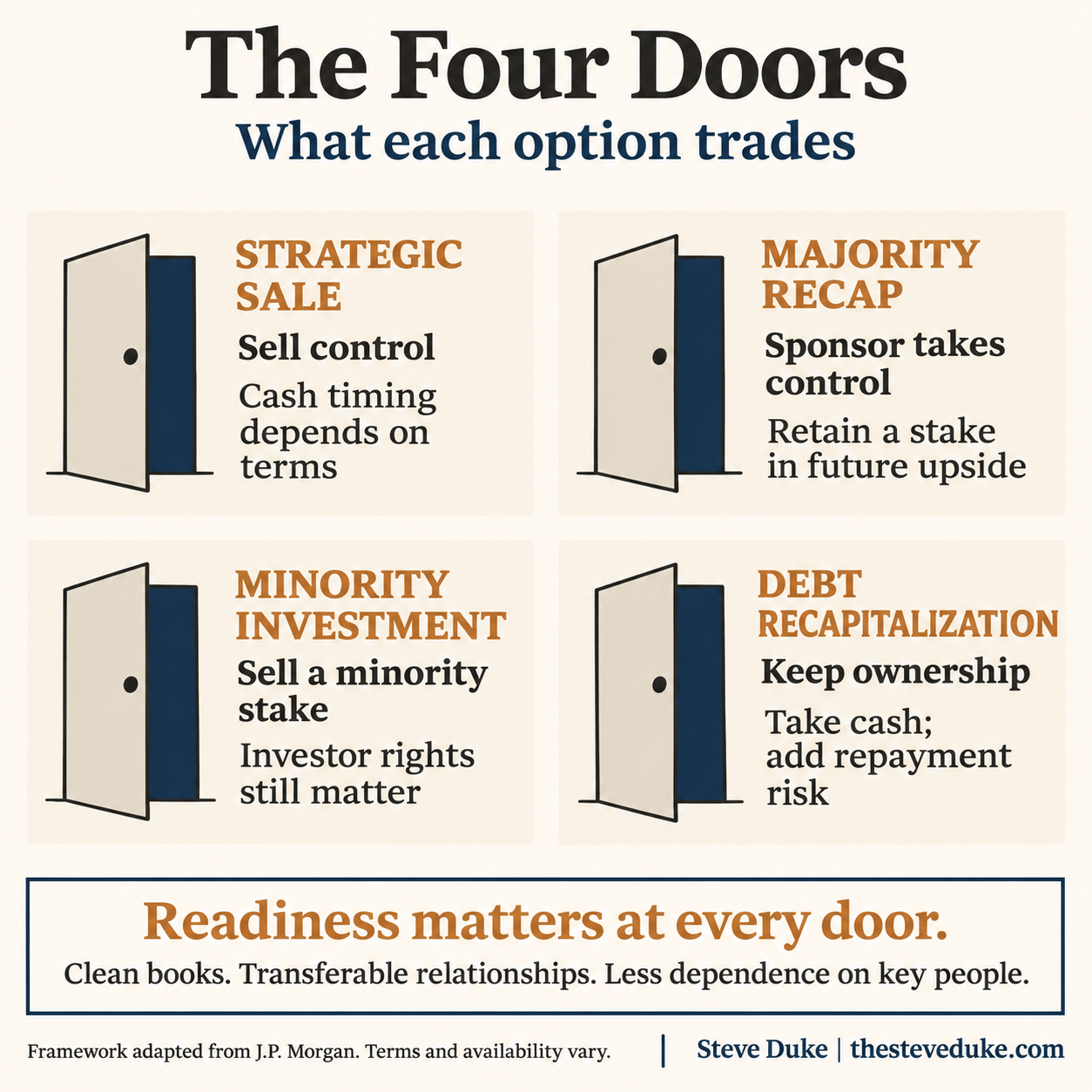
Four options, different trade-offs. Terms and availability vary. Framework adapted from J.P. Morgan.
What does each exit option look like in the lower middle market?
In the lower middle market, the strategic sale is often the most open door, while the majority recapitalization, the minority investment, and the debt recapitalization exist but tend to be narrower. What follows is my read, formed advising owner-operators, and it reflects experience more than statistics.
The strategic sale tends to have the most active market at this size. The buyer is rarely a large corporation with a formal synergy case drawn up by a bank. More often it is a competitor or a regional platform. An individual acquirer with financing may also be a potential buyer, although that is a different buyer category from a strategic acquirer. The market is real, and it is mostly private. One more point from experience: the headline price and the cash at close are often different numbers, because earnouts, escrows, and seller notes can move part of the value into the future and put it at risk.
The majority recapitalization, in its institutional form, tends to be rarer here than their table suggests. What exists instead is a smaller cousin: rolling equity into a sale to a larger platform. That can be a real second bite, priced by the platform's growth rather than your own, and it comes with governance you no longer control. A sponsor will also look hard at the team beneath you, so owner dependence can show up in the price, the structure, or the size of the rollover. Whether the trade is worth it depends largely on what you believe the platform will do with what you built.
Minority investment is, in my experience, the least common door at the smaller end of this range. When it happens, the holder is usually an industry partner or a family-office-style investor rather than a growth fund, and the real price often sits in the investor rights as much as in the dilution: consent items, vetoes, and reporting rhythms that outlive the honeymoon.
The debt recapitalization lets you keep ownership. You borrow, take a dividend, and stay at 100 percent. Whether the door is open depends on lender standards and cash-flow math rather than on appetite, and the leverage cuts both ways in a downturn. Lenders at this size may also ask for a personal guarantee, which puts personal assets behind a loan the business is meant to carry, and covenants can limit what you do next. It can appeal to an owner who wants liquidity without selling equity, but repayment comes out of future business cash flow.
The pattern across all four: the doors exist at this size, but the widths differ, and which ones are open depends on more than preference. Copying a mid-cap playbook by the door's title alone can mislead. The names are the same. The rooms are not.
Why does readiness matter for every exit option?
Readiness tends to widen or narrow every door. It starts with clean books, relationships that transfer, and a business that does not depend on its owner or two or three indispensable people. Buyers, sponsors, and lenders each tend to price that gap in their own way, and Flynn's comment that businesses with diligence issues sell for less points in the same direction. The key-employee version of the gap often shows up as a valuation haircut that follows the business into every door.
I learned what readiness looks like from inside the machine. On the systems integration side at General Dynamics, running a business unit with full P&L responsibility, I watched units get absorbed, reorganized, and re-backed, and the ones that moved cleanly were rarely the ones with the best technology. They were the ones where nothing important lived in one head. Corporate life assumes transferability. Owner-operated life tests it, and the test often arrives unannounced.
What should a business owner do first when planning an exit?
Exit planning tends to go better in this order: what you want, what the business is worth, then readiness. Here is how I walk owners through it.
First, what you want from the next chapter. Income, yes, but also role, identity, and the life on the other side. An owner who has not answered that tends to accept whatever the strongest buyer offers, because there is no other way to judge it.
Second, what the business is worth independent of what you need it to be worth. A real valuation, not a retirement number run backwards. If the only valuation you have ever had was reverse-engineered from the income you need, you may not have a valuation yet.
Third, the readiness list. That is the work, and it is largely the same work regardless of which door you eventually walk through.
Rough answers are real answers. An owner with a rough number and a rough walk-away can read an unsolicited offer, weigh it, and decline it without anyone at the plant noticing. An owner without them has to guess, in front of the person making the offer.
Preparation tends to pay off before any deal, in a company that is easier to run now. If the work only matters on closing day, it was probably not the right work. That is the Built for Options thesis, and every door in this brief is downstream of it.
If you want the four doors in one place, the Four Doors guide puts them side by side, with a readiness check and a worksheet for your walk-away number: https://thesteveduke.com/exit-options-guide?utm_source=linkedin&utm_medium=newsletter&utm_campaign=four-doors
If you want the readiness question made specific, the Owner Dependency Scorecard is a starting point for seeing where the business still leans on you, which a counterparty at any door will likely price: https://lucensys.io/owner-dependency-scorecard
Source: J.P. Morgan, “How America's Founder-Led Businesses Can Prepare For The Next Chapter,” https://www.jpmorgan.com/insights/banking/investment-banking/how-founder-led-businesses-can-prepare-for-the-next-chapter. The article cites McKinsey Institute for Economic Mobility data. I am not affiliated with J.P. Morgan, and this brief is educational, not legal, tax, or financial advice.
Steve Duke spent about 30 years learning both sides of this problem. In his corporate career, he worked for Fortune 100 aerospace companies, including GE Aerospace, Lockheed Martin, and General Dynamics. At one of these companies, he ran a multimillion-dollar business unit with full P&L responsibility. He then left to run his own company and discovered that decades of training don't protect you from becoming the business yourself. A serious health event ended it. He exited, recovered, and built Lucensys™ Group around one idea: every owner exits eventually, and the only question that matters is whether they built something that can fund what comes next.
He wrote Failure to Exit about why most owners arrive unprepared.
His next book carries an old warning for owners: the best time to plant the tree was 20 years ago. The second best time is now.
Lucensys™ Group works with owner-operated manufacturers, distributors, and industrial-services companies doing $2M–$50M — reducing owner dependence and the risk discounts that cost owners at the table.
Charlotte, NC · steve@lucensys.io · (704) 953-5608