What feels like control to the owner can look like risk to a buyer.
Most owners do not think they are the bottleneck.
They think they are being helpful.
They are solving problems.
Approving decisions.
Saving customer relationships.
Protecting quality.
Closing sales.
Keeping the business moving.
And in many cases, they are right.
The business may work because the owner is highly capable, deeply committed, and willing to step into every gap.
That is the strength.
It is also the problem.
I understand why this happens. Most owners do not create dependency on purpose. They create it by being competent, available, and willing to do whatever the business needs.
That works for a while.
Sometimes it works for years.
But from the outside, especially from a buyer’s perspective, the owner who holds everything together may also be the reason the business cannot easily transfer.
A buyer is not just asking:
How much money does this business make?
A buyer is asking:
What happens to that money when the owner steps back?
That is where owner dependence becomes more than an operating issue.
It becomes a valuation issue.
Operational Value vs. Transferable Value
There is a difference between a business that works and a business that transfers.
Operational value is what the owner can make happen.
Transferable value is what the business can make happen without the owner.
That distinction matters.
An owner-led business can be profitable, respected, and growing, yet still be fragile if the owner is central to too many critical outcomes.
The company may have customers.
But the customers trust the owner.
The company may have managers.
But the managers wait for the owner.
The company may have processes.
But the real process is still “ask the owner.”
The company may have financial reports.
But the owner is the only person who truly understands what the numbers mean.
That is not a transferable business.
That is an owner-powered business.
It may produce income.
It may even produce a very good income.
But a buyer sees the risk hiding underneath the performance.
The Owner Bottleneck Usually Starts as a Strength
Most owner bottlenecks do not begin as dysfunction.
They begin as competence.
In the early years, the owner has to do everything.
Sell the work.
Deliver the work.
Fix the problem.
Approve the spending.
Manage the customer.
Recruit the team.
Interpret the numbers.
Carry the stress.
That is how many businesses survive.
But what helps a business survive can eventually prevent it from becoming transferable.
The same decisiveness that built the company can later create dependency.
The same customer relationships that drove revenue can later create concentration risk.
The same problem-solving ability that saved the business can later prevent the team from developing judgment.
The same financial instincts that guided growth can later leave buyers wondering whether anyone else understands the economics.
That is the trap.
The owner becomes indispensable.
Then the business becomes less transferable because the owner is indispensable.
The Buyer’s Lens Is Different
This is where the owner and the buyer often look at the exact same company and see two different things.
Owners often see their central role as proof of leadership.
Buyers may see it as proof of risk.
The owner says:
“I stay close to the important decisions.”
The buyer hears:
“Decisions may stall when the owner leaves.”
The owner says:
“My customers trust me.”
The buyer hears:
“Customer relationships may not transfer.”
The owner says:
“I know the numbers in my head.”
The buyer hears:
“Financial visibility may be weak.”
The owner says:
“My people are loyal.”
The buyer hears:
“The team may be loyal to the owner, not the business.”
The owner says:
“I can still jump in whenever needed.”
The buyer hears:
“The system still depends on heroics.”
That is why owner dependence matters.
It changes how risk is perceived.
And perceived risk affects price, terms, deal certainty, and buyer confidence.
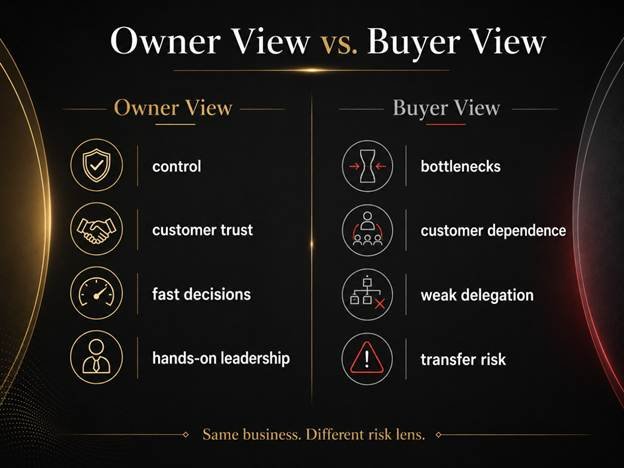
What feels like control to the owner may look like dependence to the buyer.
Where Owner Dependence Hides
Owner dependence is not always obvious.
Sometimes it is visible.
Sometimes it is buried inside daily habits.
Here are the five places I see it most often.
1. Sales Dependence
The owner is still the rainmaker.
Key relationships sit with the owner.
Important prospects want the owner in the room.
The sales story relies on the owner’s reputation, history, or personal credibility.
That may work while the owner is active.
But buyers will ask whether revenue can continue when the owner is no longer the primary relationship holder.
A business with owner-dependent sales may still be valuable.
But the buyer will usually see more risk.
2. Customer Relationship Dependence
Some owners say:
“Our customers are loyal.”
That may be true.
But loyal to what?
The company?
The team?
The process?
Or the owner personally?
If customers call the owner when something goes wrong, if they bypass the team, or if they expect direct access to the founder, the relationship may not be as transferable as the owner believes.
The buyer wants to know whether customer trust is anchored in the business, not just the person who built it.
3. Decision Dependence
Decision dependence shows up when managers technically have roles, but not real authority.
They bring decisions to the owner.
They wait for approval.
They defer on judgment calls.
They avoid risk.
They know the owner will eventually decide.
This slows the business down.
It also signals that leadership depth may be weaker than the org chart suggests.
A buyer does not want to buy a company where every meaningful decision has historically gone through the seller.
4. Operational Dependence
Operational dependence appears when the business runs on tribal knowledge.
Processes live in people’s heads.
Exceptions are handled through memory.
Quality depends on who shows up.
Customer delivery is consistent only because the owner or a few key people keep correcting the system.
That may be manageable for the current owner.
But buyers do not like invisible systems.
They want repeatable execution.
They want documented processes.
They want to know that performance is not dependent on magic, heroics, or the same three people remembering everything.
5. Financial Dependence
This one is often underestimated.
The company may have financial statements.
But does the leadership team understand them?
Are the numbers timely?
Are margins visible?
Are trends clear?
Can managers see the KPIs they need to act?
Or does the owner remain the only person who can interpret what is really happening?
If financial meaning depends on the owner, buyer confidence drops.
Buyers want financial visibility that survives the owner’s exit.
Owner dependence usually hides in sales, customers, decisions, operations, and financial.
The Valuation Problem
Owner dependence affects value because it affects confidence.
Buyers pay for future performance.
They look at historical results, but they are really trying to understand what those results mean after the ownership change.
This is the part owners hate hearing, but it matters:
Buyers do not give full credit for performance they are not sure will continue.
If the owner is central to sales, customers, decisions, operations, and financial interpretation, the buyer has to ask:
Will the business keep performing without this person?
If the answer is unclear, the buyer may still be interested.
But they will usually protect themselves.
That protection can show up as:
- a lower valuation
- tougher deal terms
- more seller financing
- a longer earnout
- heavier diligence
- more retrading pressure
- reduced buyer enthusiasm
- no deal at all
That is why owner dependence is not just an internal management issue.
It is an economic issue.
The bottleneck has a cost.
You may not see it on the income statement today.
But a buyer may price it into the deal tomorrow.
The Owner Dependence Test
Here is a simple test.
Imagine you stepped away for 90 days.
Not checked out completely.
But truly stepped back.
No daily decisions.
No customer rescues.
No special approvals.
No “just call me if you need me.”
What would slow down first?
Sales?
Customer response?
Pricing decisions?
Hiring?
Production?
Cash flow management?
Problem solving?
Quality control?
Financial reporting?
If nothing meaningful slows down, you may have built a highly transferable business.
If several things slow down immediately, the business may still depend too heavily on you.
That does not mean the business is bad.
It means the business is not yet as transferable as it could be.
Owner Dependence Is Not Solved by Working Harder
The natural owner response is often:
“I just need better people.”
Maybe.
But often the real issue is not people.
It is structure.
People cannot own decisions if decision rights are unclear.
Managers cannot own outcomes if they only receive tasks.
Teams cannot improve performance if they cannot see the right numbers.
Customers cannot trust the company if every important relationship routes back to the owner.
The owner cannot reduce dependence if the business has no repeatable systems.
Working harder does not solve that.
Adding structure does.
What Reduces Owner Dependence?
A more transferable business is built through deliberate design.
The owner has to move responsibility out of their head and into the business.
That usually requires six things.
1. Documented Processes
Critical workflows must be written down, tested, followed, and maintained.
Not documented once and forgotten.
Used.
Improved.
Owned.
A process that lives only in the owner’s head is not an asset.
It is a dependency.
2. Clear Decision Rights
People need to know what they can decide.
They need to know what they own.
They need to know what must be escalated.
Decision clarity turns delegation from vague permission into real operating power.
3. Management Accountability
Managers must own outcomes, not just activity.
That means they are responsible for results, not merely reporting problems upward.
A business becomes more transferable when capable people carry real responsibility.
4. KPI Visibility
The right people need access to the right numbers at the right time.
Not every metric.
The right metrics.
A team cannot manage what it cannot see.
And a buyer will not trust performance that only the owner can explain.
5. Leadership Depth
One strong leader is useful.
A leadership bench is transferable.
The question is not whether the owner has help.
The question is whether the business has people who can step up, lead others, and own meaningful outcomes without the owner constantly intervening.
6. Lower Owner Dependence
This is the point of the entire exercise.
The owner must deliberately reduce single points of failure, starting with themselves.
That does not mean the owner becomes irrelevant.
That is not the point.
The point is to make the business less fragile.
The owner moves from being the system to leading the system.
That is a very different business.
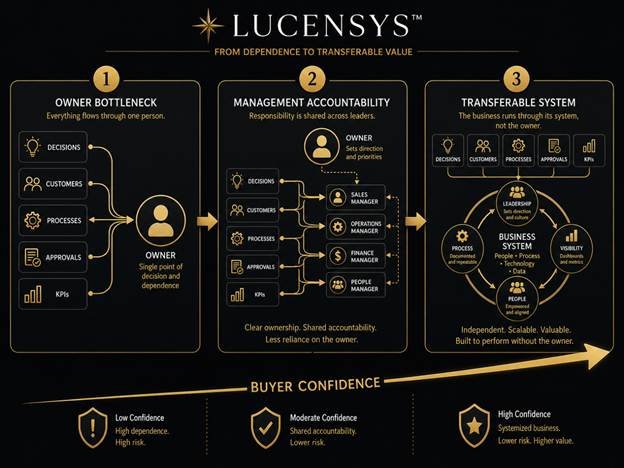
The goal is not to remove the owner. The goal is to move the owner from being the system to leading the system.
A Better Question for Owners
Most owners ask:
How do I grow the business?
That is a good question.
But it is incomplete.
A better question is:
How do I grow the business in a way that makes it less dependent on me?
That changes the work.
It forces better delegation.
Better leadership.
Better systems.
Better reporting.
Better customer transfer.
Better decision design.
It moves the company from owner-powered to business-powered.
That is where value becomes more durable.
The Self-Check
Ask yourself these questions honestly.
- What decisions still require me that should not require me?
- Which customers would become nervous if I stepped back?
- Which employees wait for my approval instead of owning outcomes?
- Which processes still live mostly in my head?
- Which numbers do I understand that my team does not?
- What would slow down first if I disappeared for 90 days?
- Would a buyer see a business, or would they see me holding the business together?
Those answers will tell you where owner dependence is hiding.
They may also tell you where value is leaking.
FAQ: Owner Dependence and Business Value
What is owner dependence?
Owner dependence means the business relies too heavily on the owner for sales, customer relationships, decisions, operations, financial interpretation, or problem-solving.
Why does owner dependence reduce business value?
Owner dependence reduces business value because it creates uncertainty about future performance after the owner exits or steps back. Buyers may discount the business, demand tougher terms, or avoid the deal if the company appears too dependent on the seller.
Is owner involvement always bad?
No.
Owner involvement is often essential, especially in earlier stages. The problem comes when the owner remains central to functions that should eventually be handled by systems, managers, processes, and customer-facing teams.
How do I know whether I am the bottleneck?
Ask what slows down when you are unavailable. If sales, decisions, customer issues, operations, or financial clarity depend on your direct involvement, you may still be the bottleneck.
How can I reduce owner dependence?
Start by documenting critical processes, clarifying decision rights, building management accountability, improving KPI visibility, developing leadership depth, and deliberately reducing single points of failure.
Where Lucensys™ Comes In
With Lucensys™, I look for the hidden dependencies that make an owner-led business harder to scale, transfer, or eventually sell.
That includes:
- owner-dependent sales
- customer relationships tied too closely to the founder
- unclear decision rights
- weak management accountability
- undocumented processes
- limited KPI visibility
- thin leadership depth
- financial visibility that depends too heavily on the owner
The goal is not to make the owner disappear.
The goal is to make the business stronger.
A stronger business can run with less owner drag.
It can make better decisions.
It can withstand disruption.
It can create more options.
And if the owner ever decides to sell, it gives a buyer more confidence that the performance can continue.
If You Want a More Objective Read
Start with one question:
Where does the business still depend too heavily on you?
If you want a more objective read, DM me Ownership and I’ll send you the Lucensys™ Owner Dependency Scorecard.
It helps identify where the business may still rely too heavily on the owner for:
- sales
- customer relationships
- key decisions
- daily operations
- financial interpretation
- problem-solving
- leadership direction
Until then, remember:
Being essential may feel good.
But being transferable creates more value.
The goal is not to be the hero forever.
The goal is to build a business that no longer needs heroics.