Your plant manager gives notice on a Monday morning.
Eighteen years of judgment walk out with him.
Every owner has run that scenario at 2am, usually more than once. The last Value Brief asked the risk questions a buyer’s diligence team will ask about how your business actually runs. This one covers the other side of the same work: what it does for you while you still own the place. The work pays you twice, and the first payment doesn’t wait for an exit.
The problem every owner feels
There’s a person in nearly every business I’ve worked with who holds a job that never made it onto any org chart. They know which machine jams when the humidity climbs. They know which customer pays late but always pays. When something breaks at 6am, the question goes to them, not to a manual. I’ve come to call this the oracle problem: one person is the answer, and the answer has no backup.
What leaves when they go is three different things wearing one badge. Knowledge: the settings, the sequence, the specs that live in one head. Judgment: what to do when the situation turns abnormal, which is exactly where the money gets made or lost. Relationships: the customer who renews because of a conversation, a handshake, a history. A two-week notice only needs one of the three to walk.
The first payment: operational effectiveness
Familiarity is a strange kind of knowledge. I can walk through my house at night with every light off and never touch a wall. That works right up until someone leaves a chair where a chair doesn’t belong. A business runs on the same arrangement. Experience keeps handing you an out-of-date map and calling it current, and a written record is what tells you the map has moved.
That’s why the first payment comes from what I call the capture loop, which has three moves. Write down what the key person knows while they’re still around to ask. Turn the recurring parts of their job into a documented process. Then let a machine carry the routine version of that process, with a person checking the work. It earns its keep even when you know the business cold, because the record catches what your memory has stopped noticing.
That machine is what people are starting to call a digital employee: software you hire for one job, which carries routine work the way a new hire would. The name matters less than the hiring frame. If you’ve been hiring people for thirty years, you already know how to do this.
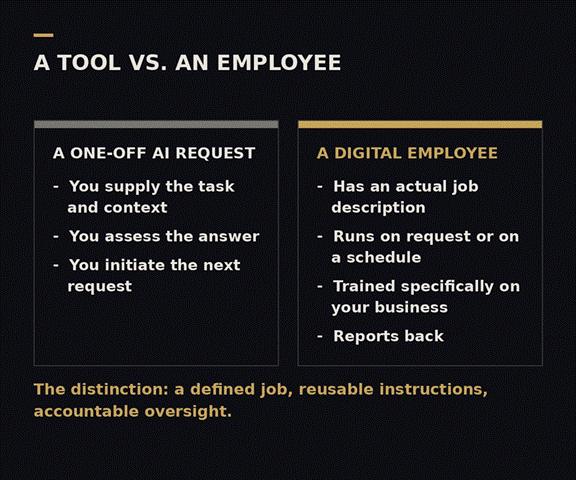
One dependency removed, from my own practice. The follow-up cadence that used to live in my head, meaning who gets contacted, when, and about what, is carried by the routine part of the system now. What I check is the judgment end: which conversation needs me and which one doesn’t. The week got shorter and nothing got less personal. I expect most owners will feel this payment first in the same form: the week gets shorter, the errors get caught, the answer is findable.
The fair skepticism on day one is that the thing is merely adequate. That’s true, and it’s the design working. Day one is the worst a digital employee will ever perform. It improves as you correct it, so adequate at install becomes considerably more than adequate a year in. The checking you do in the early weeks is how the system learns your business; the same way a new hire gets more read-throughs from a supervisor in the first months and fewer as trust is earned.
I’ve also come across companies that show how far this can go. One ten-person company is running 30 to 40 digital employees and plans to reach about 100 by year end. A seventy-person company is running 150. The careful way to state what they have is working capacity: routine work gets done and checked without adding departments, while the people on payroll spend their hours on judgment and relationships instead of repetition.
The second payment: the same work is transferability
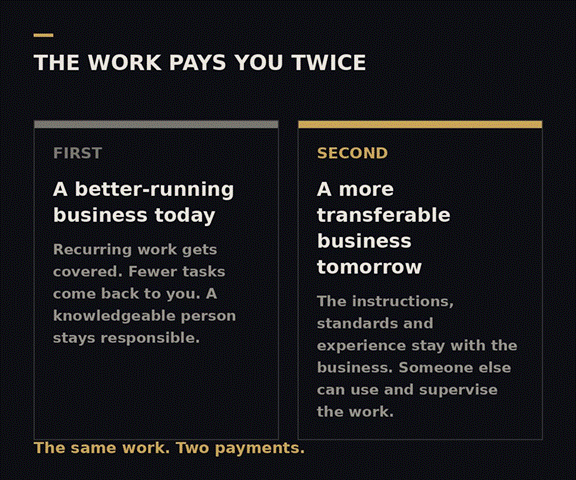
Now follow the files from the last section. The documented process that shortened quote turnaround this quarter is the same document a buyer’s diligence team reads when they ask how the business performs without its owner. Nothing new gets built for the sale. There is no documentation sprint staged six months before going to market, and no consulting project with a delivery date shaped like a closing date. The work already paid you in operations, and the same pages pay a second time the day the business changes hands.
Or the day you take a month off, which for many owners is the test that matters more than any buyer’s.
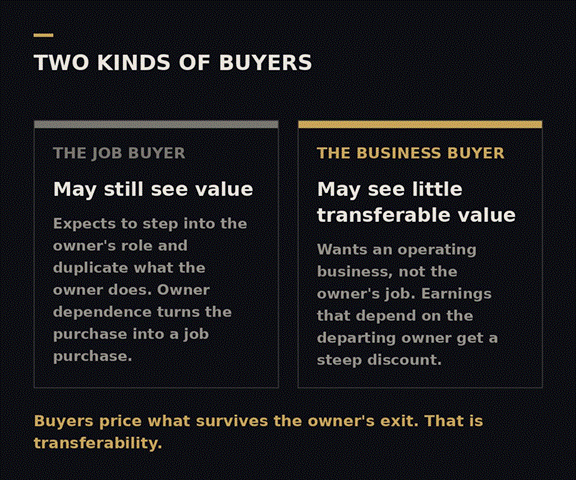
The buyer’s math is blunt: the business that repeats without its owner is the one that pencils.
Some buyers are shopping for a job, and others are shopping for a business, and only one of them pays for what survives your exit.
What gets delegated, and what never does
The routine and the record-keeping go: the follow-up cadence, the data entry, the first pass at a quote, the report that gets built the same way every Friday. Judgment and relationships stay with a person, and so does the final decision. Human review is what makes the delegation safe, and it’s also what trains the system, which is why the two travel together.
Bring one on the way you’d bring on a person. Give it the knowledge to do the job, its goals, what it can do, and just as important, what it cannot do. When the setup is done badly, the failure looks like a new hire who got no orientation, no defined lane, and no sense of what’s out of bounds. It’s the discipline you’ve applied to people for thirty years, applied to the machine.
One caution, because the same mistake can undo all of this. A digital employee that nobody documented becomes the next oracle: a new key-person dependency, only now it lives in software. Buyers’ diligence teams are increasingly likely to ask what it can touch, who approved it, and what happens if it stops. So, the standard for the machine is the standard for the business. Write down what it does, keep a record of what it can access and who signed off, and keep judgment with a person.
What is one recurring job you want handled better?
Pick one job that still depends on someone’s memory and describe it well enough that a capable new hire could do it from the page. That exercise is the first turn of the capture loop, and it costs about an hour.
I built a tool that helps business owners find where digital employees could fit in their business. It’s called the Room to Grow Explorer.
Steve Duke spent about 30 years learning both sides of this problem. In his corporate career, he worked for Fortune 100 aerospace companies, including GE Aerospace, Lockheed Martin, and General Dynamics. At one of these companies, he ran a multimillion-dollar business unit with full P&L responsibility. He then left to run his own company and discovered that decades of training don’t protect you from becoming the business yourself. A serious health event ended it. He exited, recovered, and built Lucensys™ Group around one idea: every owner exits eventually, and the only question that matters is whether they built something that can fund what comes next.
He wrote Failure to Exit about why most owners arrive unprepared.
His next book carries an old warning for owners: the best time to plant the tree was 20 years ago. The second-best time is now.
Lucensys™ Group works with owner-operated manufacturers, distributors, and industrial-services companies doing $2M–$50M — reducing owner dependence and the risk discounts that cost owners at the table.
Charlotte, NC · steve@lucensys.io · lucensys.io · (704) 953-5608