Why sellable businesses are designed before buyers ever show up.
Most owners want a business that gives them options.
They want the ability to grow.
Step back.
Bring in leadership.
Create more freedom.
Maybe sell someday.
Maybe not.
But if they ever do want to sell, they want the business to be worth what they believe it is worth.
That is reasonable.
But wanting options does not create options.
Wanting a sellable business does not make the business sellable.
Wanting transferability does not build transferability.
Transferability is built through structure.
Not hope.
Not ambition.
Not hustle.
Structure.
A business becomes transferable when it can perform without the owner being personally required for every important decision, customer relationship, process, problem, and interpretation of the numbers.
That is the distinction many owners miss.
They think transferability is something they will deal with when they are ready to exit.
It is not.
Transferability is built long before the exit conversation.
And if it is not built early, the buyer will find the weakness later.
Usually at the worst possible time.
What Transferability Really Means
Transferability is the confidence that a business can keep performing after the current owner steps back.
That does not mean the owner has no value.
It does not mean the owner disappears.
It does not mean the business becomes leaderless.
It means the business is no longer dependent on the owner as the central operating system.
A transferable business has structure.
It has leadership.
It has documented processes.
It has financial visibility.
It has customers who trust the company, not just the founder.
It has decision rights that do not bottleneck at the top.
It has people who own outcomes, not just tasks.
That is why buyers care.
Buyers are not only buying what the business has done.
They are buying confidence in what the business can keep doing.
If that confidence depends too heavily on the seller, value gets pressured.
That is the hidden tax of owner dependence.
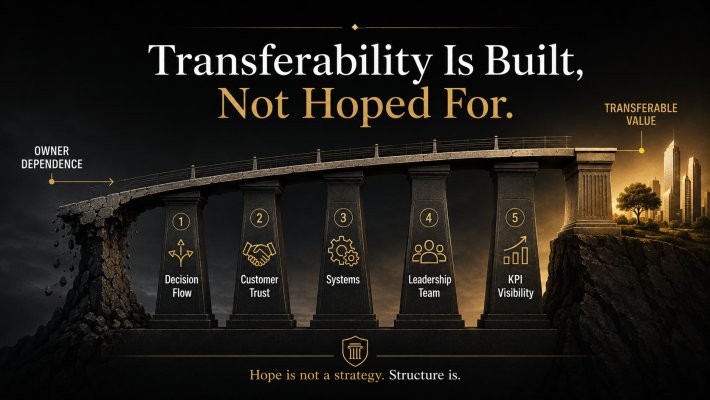
The Four Pillars of Transferability
A transferable business usually rests on four pillars.
These are not decorative.
They are load-bearing.
If one is weak, buyer confidence suffers.
1. Decision Flow
Decision flow is the way decisions move through the business.
In an owner-dependent company, decisions collect at the top.
The owner approves pricing.
The owner handles exceptions.
The owner resolves customer issues.
The owner decides priorities.
The owner becomes the traffic cop.
That may feel efficient in the short term.
It rarely scales.
It also does not transfer well.
A buyer wants to know whether the business can make good decisions without the seller standing in the middle of every meaningful choice.
A transferable business has clear decision rights.
People know what they can decide.
They know what they own.
They know what must be escalated.
They know the boundaries.
That matters because confusion slows execution.
And decision bottlenecks create dependence.
If every important decision runs through the owner, the business does not really have decision flow.
It has permission flow.
That is not the same thing.
2. Customer Trust
Many owners believe their customer relationships are a strength.
Often, they are right.
But the question is not whether customers trust the owner.
The question is whether customers trust the business.
That difference matters.
If customers call the owner directly when something goes wrong, the relationship may not fully belong to the company.
If the owner is still the main credibility source in sales, renewal, pricing, delivery, and problem resolution, buyer confidence drops.
The buyer will ask:
Will these customers stay when the owner steps back?
A transferable business moves customer trust from the founder to the company.
The customer trusts the team.
The process.
The brand.
The delivery rhythm.
The communication system.
The relationship may have started with the owner, but it cannot remain trapped there forever.
Customer trust has to become institutional.
That is what makes it transferable.
3. Systems
Systems are what allow a business to produce consistent results without relying on memory, heroics, or constant intervention.
This is where many owner-led businesses get exposed.
They have activity.
They have experience.
They have capable people.
But they do not have enough documented, repeatable systems.
Processes live in people’s heads.
Exceptions are handled differently every time.
Quality depends on who shows up.
The owner knows how everything fits together, but the business itself does not.
That may work while the owner is present.
It becomes a problem when the owner wants options.
A buyer does not want to buy invisible systems.
A buyer wants evidence.
Documented workflows.
Clean handoffs.
Repeatable delivery.
Clear accountability.
Reliable reporting.
A system does not need to be bureaucratic.
It just needs to be real.
A process that is written, followed, measured, and improved is an asset.
A process that lives only in someone’s head is a dependency.
4. Leadership Team
A business with one strong owner can operate.
A business with leadership depth can transfer.
That is a very different standard.
A leadership team is not just a group of people with titles.
It is a group of people who own outcomes.
They make decisions.
They manage people.
They solve problems.
They develop others.
They understand the numbers.
They carry parts of the business without constant owner intervention.
That kind of leadership depth matters because buyers do not want to buy a company where the seller is still the only real executive.
They want to know who will run the business after the transaction.
They want confidence that performance will continue.
They want to see that responsibility has already been distributed.
This is where a lot of owner-led companies struggle.
They have loyal employees.
They have capable people.
But not enough true leadership depth.
That gap matters.
Because when leadership depth is thin, the owner remains the backstop.
And when the owner remains the backstop, the business remains less transferable.

What Kills Transferability
Transferability does not usually fail because the owner lacks effort.
It fails because the business carries unresolved dependence.
Here are the usual culprits.
Owner Dependence
If the business cannot operate without the owner’s daily involvement, buyer confidence drops.
The owner may be talented.
The business may be profitable.
But if the owner is still required for sales, decisions, customers, operations, and problem-solving, the business is fragile.
The buyer sees a risk question:
What happens when the seller is gone?
Weak Systems
Weak systems create uncertainty.
If processes are undocumented, inconsistent, or dependent on tribal knowledge, the buyer has to wonder whether performance is repeatable.
That uncertainty affects value.
Not because buyers dislike small businesses.
Because buyers dislike surprises.
And undocumented systems are surprise factories.
Not the fun kind.
Concentration Risk
Concentration risk shows up when too much revenue, knowledge, authority, supplier power, or customer trust sits in too few hands.
It may be customer concentration.
It may be key employee concentration.
It may be sales concentration.
It may be technical knowledge concentration.
Or it may be the owner.
Concentration risk makes the business more fragile.
Fragile businesses are harder to transfer.
Poor Financial Visibility
Financial visibility is not the same as having financial statements.
The question is whether the leadership team can see what is happening clearly enough to act.
Are numbers timely?
Are margins visible?
Are trends understood?
Are KPIs connected to decisions?
If the owner is the only person who can explain performance, that is not financial visibility.
That is financial dependence.
Leadership Gaps
A thin leadership bench keeps the owner trapped.
If the owner is still the default decision-maker, problem-solver, customer rescuer, and performance interpreter, the business has not built enough leadership depth.
That may not stop the company from operating.
But it can stop it from becoming truly transferable.
Inconsistent Execution
Buyers want consistency.
Not perfection.
Consistency.
If results vary based on who shows up, which customer is involved, or whether the owner intervenes, the business has execution risk.
The more inconsistent the execution, the more skeptical the buyer.
Transferability improves when performance becomes repeatable.
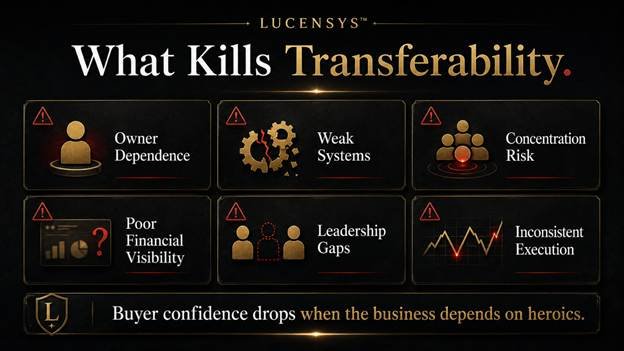
Transferability suffers when performance depends on people, memory, or heroics instead of structure.
What Builds Transferability
The good news is that transferability can be built.
But it has to be built deliberately.
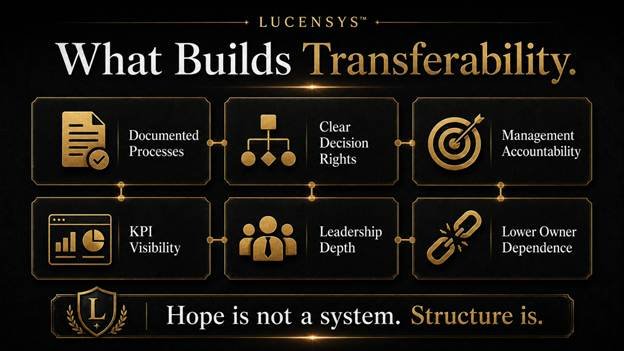
A business becomes more transferable when six building blocks are in place.
1. Documented Processes
Critical workflows are written down, tested, followed, and maintained.
Not documented once for a binder nobody opens.
Used.
Improved.
Owned.
The goal is not paperwork.
The goal is repeatability.
2. Clear Decision Rights
People know what they can decide.
They know what they own.
They know what must be escalated.
Decision rights reduce bottlenecks.
They also build confidence.
Internally, the team moves faster.
Externally, a buyer sees less dependence on the owner.
3. Management Accountability
Managers own outcomes, not just activity.
That means they are responsible for results.
Not merely reporting problems upward.
Not waiting for the owner to make the real decision.
Not using “I told you about it” as a management system.
A transferable business needs people who carry responsibility.
4. KPI Visibility
The right people can see performance clearly enough to act.
Not 47 dashboards.
Not vanity metrics.
Not spreadsheet theater.
The right numbers.
At the right time.
Connected to the right decisions.
KPI visibility matters because a team cannot manage what it cannot see.
And a buyer will not trust performance that only the owner can explain.
5. Leadership Depth
A second tier of leaders can step up when needed.
This is not about titles.
It is about capability.
Can they make decisions?
Can they lead people?
Can they solve problems?
Can they own outcomes?
Can they operate without the owner constantly intervening?
That is leadership depth.
6. Lower Owner Dependence
This is the point.
The owner deliberately reduces single points of failure, starting with themselves.
That does not mean the owner becomes irrelevant.
It means the owner moves from being the system to leading the system.
That is what creates options.
The Sequence Matters
Owners sometimes want to jump straight to transferability.
That is understandable.
Transferability is the attractive outcome.
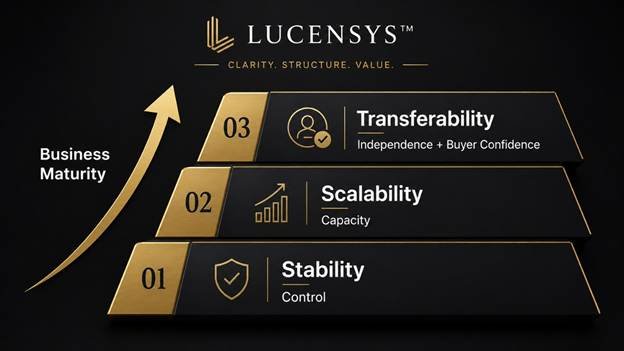
But businesses usually have to move through stages.
Stability.
Scalability.
Transferability.
Stability gives you control.
Scalability gives you capacity.
Transferability gives you independence and buyer confidence.
If the business is still fighting basic consistency problems, trying to solve transferability directly may be the wrong fix.
Wrong stage.
Wrong fix.
Slow progress.
A business that cannot reliably deliver today will not become transferable tomorrow just because the owner wants an exit someday.
The work has to happen in sequence.
First, create stability.
Then build scalability.
Then improve transferability.
Each stage unlocks the next.
A Simple Self-Check
Here are five questions worth asking.
Not someday.
Now.
1. If I disappeared for 90 days, what would slow first?
Sales?
Operations?
Customer response?
Cash flow?
Pricing?
Hiring?
Problem-solving?
Whatever slows first is probably where transferability is weakest.
2. Who owns key decisions besides me?
Not who has a title.
Who actually owns decisions?
Can you name the person?
Can they make the call?
Does the team know they have that authority?
If not, you may have delegation theater, not decision flow.
3. Are customer relationships attached to the business or to me?
If customers still expect direct access to the owner, the relationship may not fully transfer.
That does not mean the relationship is bad.
It means the business needs to institutionalize trust.
4. Are our systems documented and followed?
Documentation alone does not count.
A process has to be used.
Maintained.
Improved.
Measured.
If it sits in a folder untouched, it is not a system.
It is business wallpaper.
5. Would a buyer see an asset or owner-powered income?
This is the uncomfortable question.
A business that needs the owner to run may still produce income.
But transferable value requires more.
It requires confidence that the business can keep performing without the current owner holding it together.
Why This Matters Even If You Do Not Plan to Sell
Some owners resist transferability because they think:
“I am not ready to sell.”
Fair enough.
But transferability is not only about selling.
It is about options.
A more transferable business is usually also:
- easier to manage
- less fragile
- less dependent on the owner
- more attractive to lenders or investors
- easier to transition internally
- more resilient during disruption
- more valuable if an unexpected opportunity appears
You do not have to sell.
But you should build so that you could.
That distinction changes everything.
Because when a business is transferable, the owner has more freedom.
Freedom to stay.
Freedom to grow.
Freedom to step back.
Freedom to bring in leadership.
Freedom to sell.
Freedom to wait.
Transferability creates options before it creates an exit.
FAQ: Transferability and Business Value
What is a transferable business?
A transferable business is a business that can keep performing without the current owner being personally required for daily decisions, customer relationships, sales, operations, financial interpretation, or problem-solving.
Why does transferability matter to buyers?
Transferability matters because buyers are trying to determine whether historical performance will continue after the ownership change. The more the business depends on the current owner, the more risk the buyer sees.
Can a profitable business still lack transferability?
Yes. A business can be profitable and still be difficult to transfer if performance depends too heavily on the owner, a few key people, undocumented processes, concentrated customers, or weak financial visibility.
Is transferability only important if I want to sell?
No. Transferability also creates more owner freedom, stronger leadership, better resilience, and more strategic options. Even owners who do not plan to sell benefit from building a business that is less dependent on them.
How do you build transferability?
You build transferability by documenting critical processes, clarifying decision rights, creating management accountability, improving KPI visibility, developing leadership depth, transferring customer trust to the business, and lowering owner dependence.
Where Lucensys™ Comes In
With Lucensys™, I look at transferability as a business design issue.
Not a last-minute exit project.
That means looking at:
- how decisions flow
- where customer trust sits
- whether systems are documented and followed
- whether managers own outcomes
- whether KPIs are visible and useful
- whether leadership depth exists
- how much the business still depends on the owner
- whether buyers would believe the future performance story
The goal is not to make the owner irrelevant.
The goal is to make the business less fragile and more valuable.
A stronger business gives the owner more options.
And if the owner eventually decides to sell, it gives the buyer more confidence.
That is the point.
If You Want a More Objective Read
Start with one question:
Can the business keep performing without you?
If you want a more objective read, DM me Transferability and I’ll send you the Lucensys™ Transferability Scorecard.
It helps identify where the business may still need stronger:
- decision flow
- customer trust
- documented systems
- leadership depth
- KPI visibility
- management accountability
- owner independence
Until then, remember:
Transferability is not wished into existence.
It is designed.
It is built.
And it usually starts long before the owner thinks they need it.