Every owner exits eventually
Every business owner will leave their business someday. Some will sell, some will hand it to family or employees, and some will close the doors. Some will leave on their own terms and their own timeline. Others will leave because a health event, a partner dispute, a market shift, or an unexpected offer changed their plans.
I have spent my career on both sides of this problem: first as an engineer and business unit leader in aerospace, then as an owner who had to exit his own company. What I have seen repeatedly is that the owners who do best are rarely the ones who found the best buyer. They tend to be the ones who started preparing early.
This article explains what exit planning is, why it deserves a place on your calendar before you are ready to leave, and the four-step Duke Method at the heart of my work at Lucensys.
What exit planning is
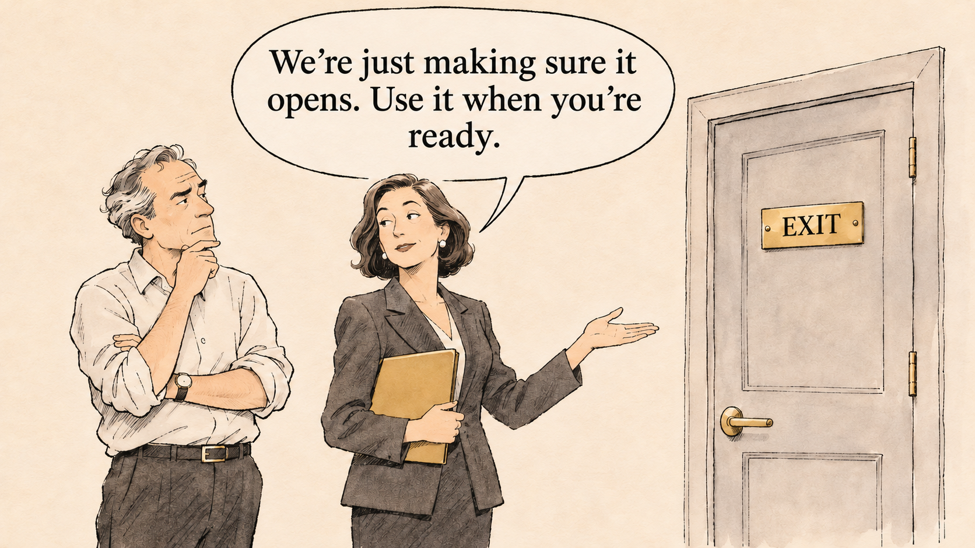
Exit planning is the process of preparing an owner, a business, and the owner's personal finances for a successful transition. Successful is defined by the owner: a price, a timeline, a legacy, a future for employees, or some mix of these.
A closing is an event. Exit planning is the work that comes before it: the decisions about what you want, what the business needs to become, and how your personal finances fit the plan.
It covers three questions at once. Is the business valuable and transferable? What do you want your next chapter to look like? And how much money will you need to support it?
It is also broader than selling to an outside buyer. A transition might involve family, a management team, or employee ownership. Planning gives you time to examine which paths fit your goals and what each would require.
An M&A transaction focuses on completing a deal. Exit planning begins earlier, with whether, when, to whom, and on what terms you might eventually transfer the business. The two disciplines work well together, and the planning ideally comes first.
Why it matters
The most direct reason is value. Buyers need confidence that a business can keep performing after the owner leaves. When customer relationships, pricing decisions, or technical knowledge depend on one person, that creates questions about what will survive the handover. Customer concentration, weak financial reporting, and a thin management bench can create similar concerns. Those weaknesses can affect price, deal terms, or whether a buyer proceeds. Lucensys Ballpark Valuation
The second reason is options. Preparation can put you in a better position to decline a weak offer, wait, or decide to stay. In my view, options are what exit planning really provides.
You may be thinking that this can wait until you are ready to exit. That is understandable. The business needs your attention today.
But consider the work involved: documenting processes, developing capable managers, reducing dependence on a few customers, and producing financial reports you can trust. Those changes have a purpose while you still own the business. In my experience, they can make it easier to run and more enjoyable to own. You do not have to sell to benefit from the preparation.
The third reason is personal. A business can be both a major financial asset and a large part of an owner's identity. In my experience, owners who think hard about the money often give far less thought to what they will do the day after the sale. Deciding what comes next belongs in the plan as much as the valuation does.
The fourth reason is everyone else. Employees, family members, customers, suppliers, and partners have a stake in the business getting through a transition intact. Planning gives you time to consider what continuity means for them, too.
Myths that keep owners waiting
“I am not ready to sell, so I do not need a plan.”
You can prepare the business without committing to a sale. You may decide to keep it and run it differently. The work still matters.
“The business will fund my retirement because a buyer will pay what it is worth.”
What you need the business to be worth and what a buyer will pay can be very different numbers. Your plan needs to examine that gap rather than assume it will close on its own.
“I will start when I am closer to retiring.”
Developing managers, transferring relationships, and demonstrating that the business can operate without you take time. Waiting can leave you trying to explain weaknesses that you could have addressed earlier.
“Exit planning is only for large companies.”
A smaller business still needs a plan for what happens when its owner steps away. If much of the company's knowledge, authority, and customer trust sits with you, that is a reason to start preparing.
The Duke Method: four steps
One of my business gurus is Yogi Berra. A line often attributed to him gets to the heart of this:
“If you don’t know where you are going, you might wind up someplace else.” Source
That is a reasonable summary of why planning matters.
The Duke Method is the core of how I work with owners at Lucensys. It is a way to build a better business, one that gives you more options whenever you want them. Exit planning is one place it applies. The four steps are Determine, Understand, Know, and Execute.
D: Determine where you want to go.
Start with what you want the business to make possible. When would you like to step away? What would you need financially? Who, if anyone, would you like to take over? What would you want your life to look like afterward?
Tools can help make those questions more concrete. The Personal Success Snapshot helps clarify what success means to you personally. The Freedom Date Calculator is a done-with-you tool that explores the financial side: the income you would like your future to support and the capital that could require. Neither can choose your destination for you, but they can help you put more specific answers on paper.
U: Understand where you are starting.
Take an honest look at the business today. What might it be worth, and how does that compare with what you need? Could it keep running if you were away for three months?
The Lucensys Ballpark Valuation Estimator provides an initial estimate of value. A deeper look might call for the Business Stability & Owner Independence Review, the Business Scalability & Growth Review, or the Business Transferability & Owner Options Review, depending on what needs to be understood.
These reviews examine different questions: how reliably the business operates, whether it can grow without adding strain, and how well it could continue under someone else's leadership. The purpose is to understand where the business stands and which weaknesses could get in the way of your plans.
K: Know the path. E: Execute the plan.
These two steps come down to good old-fashioned project management. Start with SMART goals: specific, measurable, achievable, relevant, and time-bound. Then decide what needs to happen, in what order, who is responsible, and when each step should be completed.
Lucensys tools such as the Priority Engine, Decision Lens, and Independence Action Plan can help organize that work. The plan should make clear what deserves attention first, why it matters, and how the work will get done.
Throughout the Duke Method, identify the key performance indicators (KPIs) that will tell you whether you are moving toward your goals. Establish a starting point and a target, then monitor progress regularly. Completing tasks matters, but so does checking whether those tasks are producing the results you intended. Use what you learn to adjust the plan.
Why this matters to me
I care deeply about business owners. Exit planning is one way to help them protect what they have built and give themselves more choices. Still, I sometimes hesitate to use the phrase. The word “exit” can sound like someone is asking you to leave a business you have spent years building. I understand why that might put you on the defensive.
But getting ready to leave does not commit you to leaving. It gives you more say in what happens next.
The Exit Planning Institute reports that only 20–30% of businesses that go to market ultimately sell. Even completing a sale does not necessarily mean an owner receives the price or terms they had hoped for.
As a business owner myself, I find that deeply troubling. Behind those outcomes are years of work, personal sacrifices, employees, families, and plans for the future. The thought of an owner reaching that point and discovering they have fewer choices than they expected is hard to accept.
Whether you work with me or someone else, please give this the attention it deserves. Get your business ready to continue without you, whether or not you intend to leave. You can decide later what to do with that freedom. The preparation needs to begin earlier.
Steve Duke spent about 30 years learning both sides of this problem. In his corporate career, he worked for Fortune 100 aerospace companies, including GE Aerospace, Lockheed Martin, and General Dynamics. At one of these companies, he ran a multimillion-dollar business unit with full P&L responsibility. He then left to run his own company and discovered that decades of training don't protect you from becoming the business yourself. A serious health event ended it. He exited, recovered, and built Lucensys™ Group around one idea: every owner exits eventually, and the only question that matters is whether they built something that can fund what comes next.
He wrote Failure to Exit about why most owners arrive unprepared.
His next book carries an old warning for owners: the best time to plant the tree was 20 years ago. The second best time is now.
Lucensys™ Group works with owner-operated manufacturers, distributors, and industrial-services companies doing $2M–$50M — reducing owner dependence and the risk discounts that cost owners at the table.
Charlotte, NC · steve@lucensys.io · (704) 953-5608