Why Growth Alone Doesn’t Make a Business Sellable
Revenue growth may attract attention. Transferability is what creates buyer confidence.
Growth can hide a fragile business.
Many owners assume that if revenue is rising, the company will be easier to sell someday.
Buyers do not see it that way.
Buyers do not pay for growth alone. They pay for confidence.
Confidence that the business will keep performing after the current owner steps back, sells, or disappears from the daily machinery.
That is where many owners get surprised.
A business can be growing, profitable, and still create concern in the mind of a buyer. It may attract interest, then get discounted, re-traded, or rejected once diligence exposes how dependent the company is on the owner, a few key people, a few customers, or undocumented processes.
In my work with owner-led companies, I see the same pattern repeatedly:
Owners focus on growth. Buyers pay for transferability.
Transferability is the confidence that the business will keep performing without the current owner being the glue, traffic cop, rainmaker, and chief problem-solver.
That is the difference between a growing business and a transferable asset.
The 2×2 Every Owner Should Understand Before Thinking About Selling
A business is not sellable just because it is growing.
A business becomes more sellable when growth is supported by systems, leadership depth, clean financials, repeatable processes, diversified customers, and low owner dependence.
The question is not simply:
Is the business growing?
The better question is:
Is the business growing in a way that someone else would confidently pay to own?
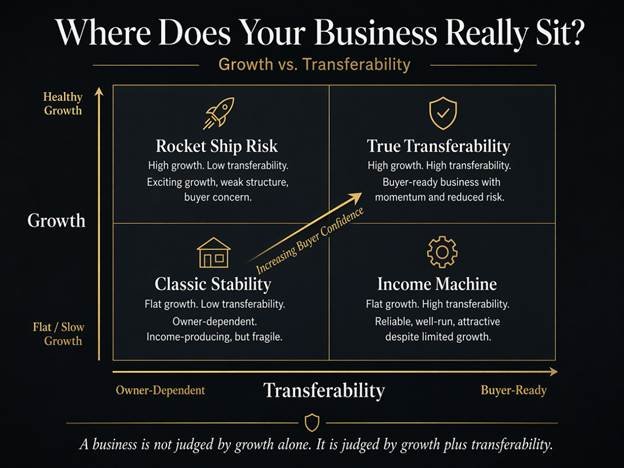
That requires looking at two independent axes.
Growth: Is the business flat, or growing at a healthy rate?
Transferability: Could the business run well without the owner, in the hands of a capable buyer?
That gives us a simple 2×2 grid:
- Low growth vs. healthy growth
- Low transferability vs. high transferability
From that grid, four patterns emerge:
- Classic Stability
- Rocket Ship Risk
- Income Machine
- True Transferability
These four patterns explain why owners often misread their own companies. Revenue tells part of the story. It does not tell the whole story.
What Transferability Actually Means
Transferability is the degree to which a business can continue to perform without the current owner being personally required for sales, delivery, decisions, customer relationships, problem-solving, or daily control.
A transferable business is not merely profitable.
It is understandable, repeatable, and de-risked.
That matters because buyers are not only buying past results. They are buying confidence in future performance.
The more a business depends on the owner personally, the more buyer confidence drops.
The more buyer confidence drops, the more value, terms, and deal certainty come under pressure.
That is the hidden cost of owner dependence.
The Three Layers of Business Maturity
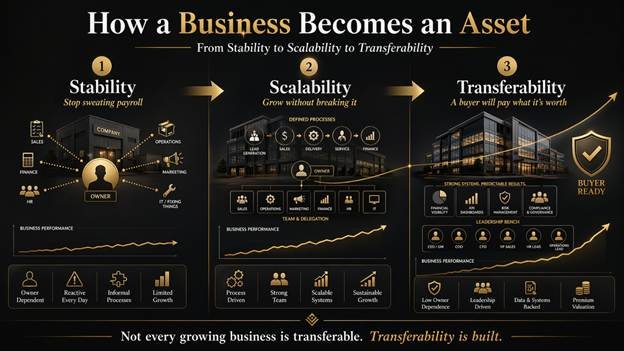
Inside the Lucensys™ framework, every owner-led business sits somewhere within three maturity layers:
- Stability
- Scalability
- Transferability
These are not buzzwords. They are stages of business maturity.
You do not jump straight to transferability. Businesses move through stages. Skipping stages creates the illusion of progress while the foundation remains unstable.
Stability gives you control.
Scalability gives you capacity.
Transferability gives you independence and buyer confidence.
Wrong stage. Wrong fix. Slow progress.
That is why the sequence matters.
Stability: Stop Sweating Payroll
Stability is when the business is no longer in survival mode.
Cash flow covers payroll and basic expenses. The company exists. It may provide a good living. It may support employees, customers, and the owner’s family.
But the owner still makes most key decisions, holds key relationships, and carries most of the risk.
From a buyer’s perspective, the question is not whether the business works today.
The question is whether future cash flow is durable, or whether it is attached to the current owner’s effort.
A stable business can be useful, profitable, and important.
But stability by itself does not make a business buyer-ready.
Scalability: Grow Without Breaking It
Scalability is when increased revenue does not blow up the business.
The company is hiring, building processes, delegating real responsibility, and handling more volume without constant chaos.
Growth is no longer a heroic act.
That is progress.
But scalability alone is not the finish line.
A company can grow and still be difficult to buy if the growth depends too heavily on the owner, a fragile team, weak systems, poor reporting, or customer concentration.
That is why growth must be tested against transferability.
Transferability: A Buyer Will Pay What It Is Worth
Transferability is when a capable buyer can step in and the business keeps performing.
Systems, financials, people, customers, and decision rights are structured, so the business is an asset, not a job attached to one owner’s personality.
Most owners think they are somewhere in Scalability.
Many assume they are close to Transferability.
Far fewer businesses reach that top layer than owners expect.
Transferability is where business value becomes more durable.
Pattern 1: Classic Stability
Flat growth. Low transferability.
This is where many owner-led businesses live for long stretches of their lifespan.
Revenue is flat or creeping along.
The owner is central to sales, decisions, relationships, approvals, and problem-solving.
If the owner disappears for three months, everyone gets nervous.
This can still be a decent business. It can pay the owner well. It can support employees and customers.
But buyers are not just asking whether the business exists today.
They are asking whether the earnings will survive a change in ownership.
That is the problem.
Classic Stability may produce income, but it often does not create a sellable asset at the price the owner expects.
The business is stable enough to operate, but not structured enough so that a buyer can trust the future cash flows.
The buyer risk is obvious:
If the owner is still the system, the buyer is not really buying a company.
The buyer is buying dependence.
Takeaway: A stable business can produce income, support employees, and serve customers, but if the owner is still central to decisions, relationships, and problem-solving, buyers may see dependence instead of durable value.
Buyer concern: The business may produce income, but the future cash flow still depends too heavily on the owner.
Pattern 2: Rocket Ship Risk
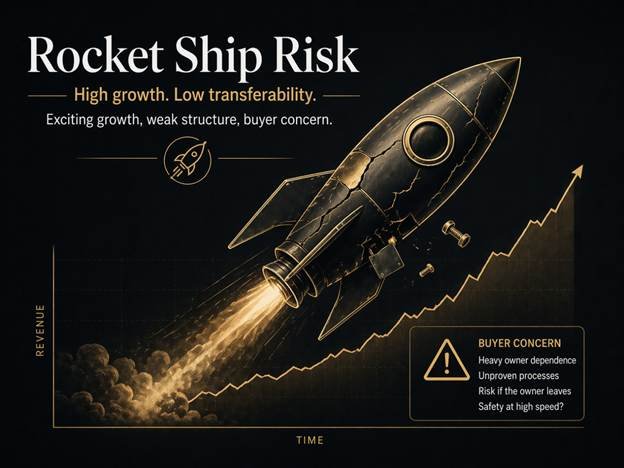
High growth. Low transferability.
This is the first edge case, and one I see often.
I call this Rocket Ship Risk.
Revenue is growing fast.
The owner is the rainmaker and the traffic cop.
Systems, processes, leadership depth, reporting, and decision rights lag behind the revenue curve.
From the owner’s perspective, everything feels exciting.
The company is moving. The numbers are up. The story sounds strong.
From a buyer’s perspective, everything can feel fragile.
The business may look great in a pitch deck, but when someone digs in, they may see concentration risks, undocumented processes, thin management, messy financial visibility, and key dependencies that make the future uncertain.
Deals in this quadrant often:
- attract interest
- get heavily discounted
- get retraded after diligence
- fall apart entirely
High growth is not a substitute for transferability.
In fact, rapid growth without structure often increases risk.
That is the trap.
The owner sees momentum.
The buyer sees volatility with a logo.
Takeaway: Fast growth can create excitement, but if the business still depends on the owner, weak systems, thin leadership, or unclear reporting, buyers may see volatility instead of value.
Buyer concern: The growth may not survive without the owner personally holding the business together.
Pattern 3: The Income Machine
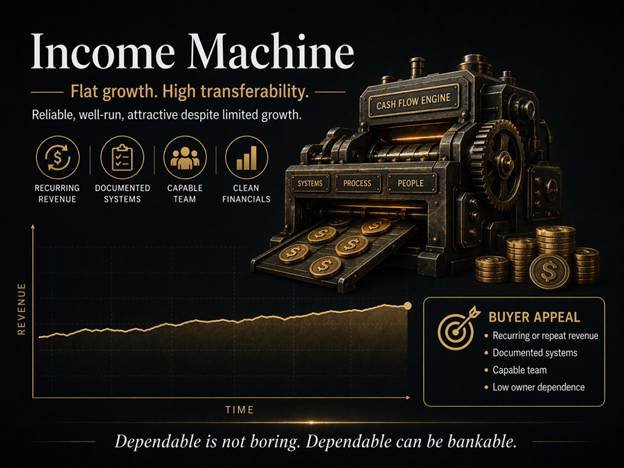
Flat growth. High transferability.
The second edge case is less obvious, but strategically important.
I call this The Income Machine.
Revenue is flat or only slowly rising.
But the business is operationally excellent.
It may have:
- strong recurring or repeat revenue
- documented systems
- a capable team
- clean financials
- predictable delivery
- low owner dependence
The owner could step away for months without the business falling apart.
Sometimes this happens because the business has largely saturated its niche. It may own its local or vertical market. There may be no obvious growth path without diversifying products, geographies, channels, or customer segments.
From a growth chart standpoint, it looks stuck.
From a buyer’s standpoint, it may be exactly what they want.
A steady income stream with low volatility.
A tuck-in acquisition that bolts cleanly into a larger platform.
A lifestyle asset for someone who wants reliable cash flow more than explosive growth.
This is why growth and transferability need to be separated.
A flat business can still be a very solid asset if it is structurally sound.
The buyer risk is lower because the business is not dependent on magic, heroics, or the owner’s daily intervention.
It may not be flashy.
But in M&A, dependable is not boring.
Dependable can be bankable.
Takeaway: A business does not need explosive growth to be valuable. If it has reliable cash flow, documented systems, capable people, and low owner dependence, it may still be a highly attractive asset.
Buyer concern: The upside may be limited, but the risk may be lower because the business is dependable and easier to transfer.
Pattern 4: True Transferability
Healthy growth. High transferability.
This is the ideal.
A transferable business combines:
- healthy, sustainable growth
- low owner dependence
- clear leadership roles
- repeatable systems
- clean financial reporting
- diversified customers
- a credible future growth story
The owner leads the business, but is not the business.
There is a leadership bench with real authority.
Processes are documented and followed.
Customers, suppliers, and key employees are diversified and not overly concentrated.
Financials are timely, accurate, and transparent.
The company has a clear growth story, but that story does not depend on the owner personally forcing every important outcome.
This is the top-right of the grid.
The business is both growing and structurally de-risked.
These are the companies that tend to sell faster, attract stronger buyers, support better terms, and create less drama in diligence.
The buyer risk is lower because the buyer can believe the future performance story.
That is the real prize.
Takeaway: This is the ideal position. The business is growing, structured, and capable of performing without the owner driving every critical outcome.
Buyer concern: Lower concern. Buyers can believe the future performance story because the business has both momentum and structure.
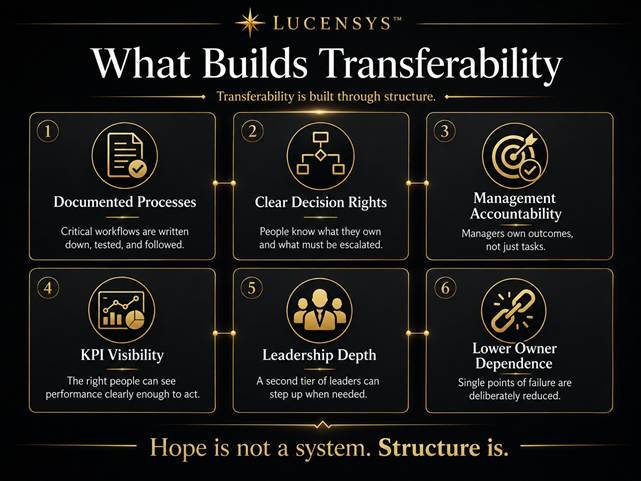
What Actually Builds Transferability?
Transferability is built through structure.
Not ambition.
Not hustle.
Not luck.
Structure.
A business becomes more transferable when six building blocks are in place:
- Documented processes Critical workflows are written down, tested, followed, and maintained.
- Clear decision rights People know what they can decide, what they own, and what must be escalated.
- Management accountability Managers own outcomes, not just tasks.
- KPI visibility The right people can see performance clearly enough to act.
- Leadership depth There is a second tier of leaders who can step up when needed.
- Lower owner dependence The owner deliberately reduces single points of failure, starting with themselves.
Hope is not a system.
Structure is.
Why This Matters Before You Are Ready to Sell
Even if you are years away from an exit, or think you may never sell, this framework still matters.
If you are in Classic Stability, your risk is stagnation. The business can become a job you cannot leave.
If you are in Rocket Ship Risk, your risk is burnout and disappointment. You may create impressive growth, then face a painful valuation conversation later.
If you have an Income Machine, your risk is under-leveraging it. There may be strategic buyers who value the reliability more than you do.
If you are in True Transferability, your risk is complacency. It is tempting to coast instead of continuing to protect and improve what makes the asset valuable.
Thinking in terms of both growth and transferability gives you a clearer picture of where you are and what you should work on next.
It also changes the planning conversation.
Instead of asking:
How do we grow more?
You start by asking:
What kind of growth are we creating, and would a buyer trust it?
That is a better question.
It is also a more expensive question to ignore.
How to Know Whether Your Business Is Sellable
A sellable business usually has more than revenue growth.
It has evidence that performance is transferable.
Look for these signs:
- the owner is not required for most daily decisions
- sales do not depend on one person
- customer concentration is controlled
- financial reporting is timely and clear
- processes are documented and followed
- leadership roles are defined
- the team can execute without constant owner intervention
- recurring or repeat revenue is visible
- buyers can understand how the company makes money
If those elements are weak, the business may still be profitable.
But it may not be buyer-ready.
A Simple Self-Check for Owner-Led Businesses
Ask yourself:
- Over the last 3 to 5 years, has revenue grown meaningfully, or is it essentially flat?
- If I disappeared for three to six months, what would actually happen to sales, delivery, cash flow, and decision-making?
- Are my systems documented, or do most things live in people’s heads, especially mine?
- Do I have a real leadership bench, or just capable people waiting for my decisions?
- Are customers, suppliers, and key employees diversified, or is the business exposed to a few major relationships?
- Would a buyer see a resilient asset here, or a risky job with a logo?
Your honest answers will tell you roughly which quadrant you are in.
They may also tell you why growth has not created the value you expected.
Frequently Asked Questions About Growth, Transferability, and Business Value
Does revenue growth make a business easier to sell?
Not by itself.
Revenue growth can help, but buyers also look for transferable performance, clean financials, leadership depth, customer diversification, documented systems, and low owner dependence.
What makes a business transferable?
A business is transferable when it can keep performing without the current owner being central to sales, operations, customer relationships, decisions, and problem-solving.
Why do buyers discount owner-dependent businesses?
Buyers discount owner-dependent businesses because future performance is less certain after the owner exits.
If the owner is the system, the buyer is purchasing risk, not just earnings.
Can a flat-growth business still be valuable?
Yes.
A flat-growth business can still be valuable if it has stable cash flow, repeat customers, documented systems, capable leadership, clean financials, and low owner dependence.
What is exit readiness?
Exit readiness means the business is prepared for a sale or transition before the owner needs one.
It includes financial readiness, operational readiness, leadership readiness, transferability, and personal planning.
Where Lucensys™ Comes In
With Lucensys™, I look at two things in combination:
- hard financial data, including growth rates, margins, concentration, and trends
- structured transferability factors, including people, processes, customers, leadership depth, decision flow, systems, and risk
That lets me place a company more objectively in:
- Stability
- Scalability
- Transferability
It also helps identify whether the company is really a Rocket Ship Risk or an Income Machine.
From there, the conversation changes.
It is no longer:
Are we growing?
It becomes:
Are we building something someone else would confidently pay to own?
That is the distinction that matters.
If You Want Clarity on Your Own Business
Start with the 2×2 question:
Are you growing, and are you transferable?
Then be honest about the quadrant.
Which one are you in?
- Classic Stability
- Rocket Ship Risk
- Income Machine
- True Transferability
If you want a more objective read, DM me Transferability and I’ll send you the Lucensys™ Transferability Scorecard.
It looks at the two things that actually matter:
- how the business is performing
- whether it can keep performing without you
In future editions of The Lucensys™ Value Brief, I will go deeper into:
- what specifically moves a business from Stability to Scalability
- how to convert Rocket Ship Risk into a truly transferable asset
- how to know when your Income Machine may be worth more to someone else than it is to you
Until then, remember:
Growth is good.
Transferability is strategic.
You do not have to chase scale, but you should always know whether you are building a job or building an asset.